AU
AU
 NZ
NZ
 UK
UK

Video
FRP Best Practices for Cutting, Drilling, Connections and Resealing | Treadwell Tech Talk
Overview: FRP Best Practices for Site Work
This Tech Talk Tuesday session explores practical FRP best practices for working with fibreglass reinforced polymer on-site. The focus is on simple, repeatable methods for:
- Cutting FRP profiles and gratings
- Drilling and hole preparation
- Designing and tightening bolted connections
- Resealing cut or damaged edges
- Safe handling and dust control
These recommendations are based on Treadwell’s field experience across industrial and public infrastructure projects. They are intended as general guidance and not as site-specific engineering advice.
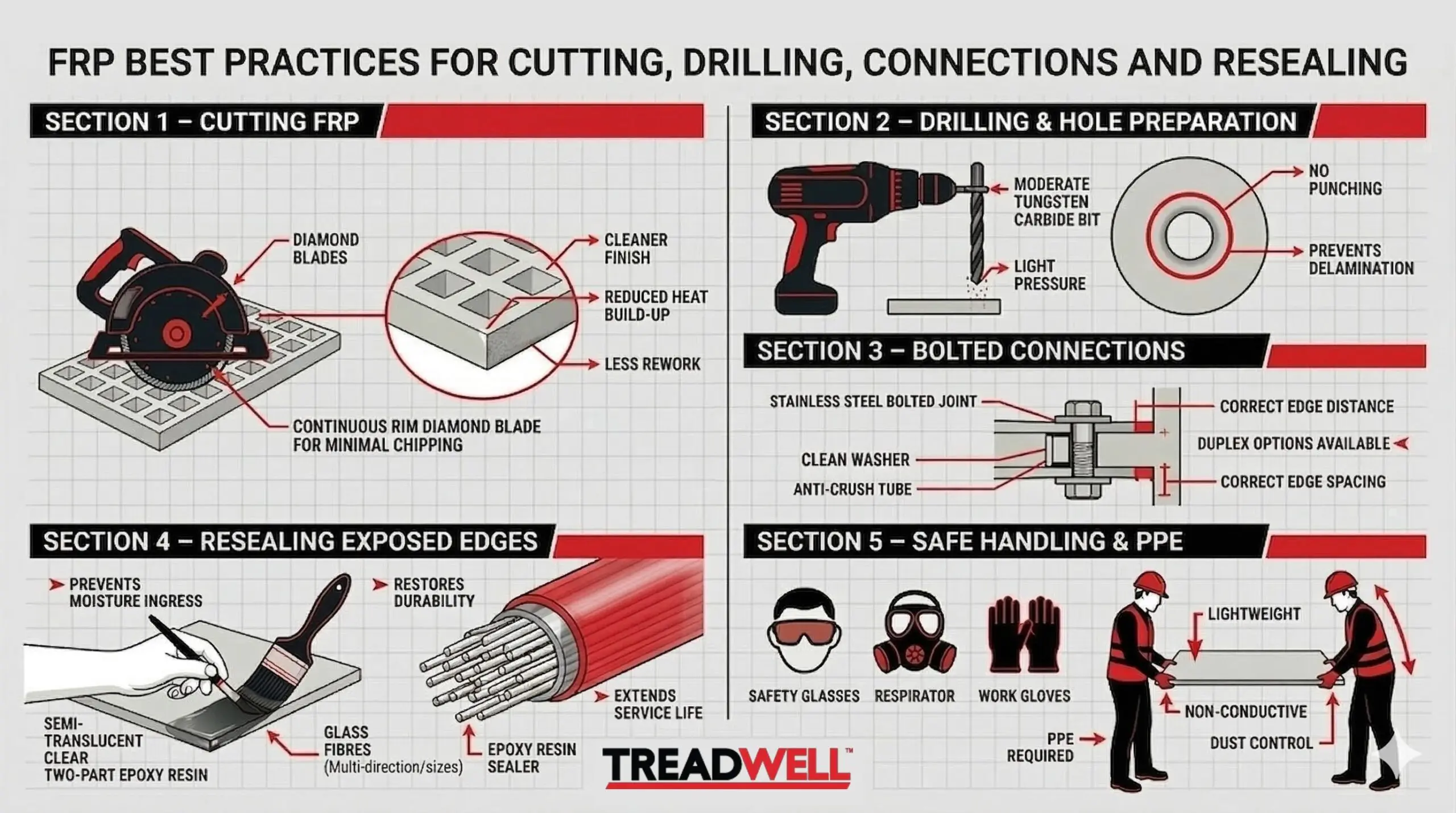
Key Benefits
Cleaner, Faster Cutting on Site
- Diamond blades for best results
Continuous rim diamond blades provide clean cuts, minimal chipping and reduced heat buildup compared to segmented concrete blades. This preserves resin around the glass fibres and improves appearance.
- Flexible tool options
Circular saws, angle grinders, jigsaws and reciprocating saws can all be used as long as they are fitted with suitable diamond tooling.
- Less rework and fewer blade changes
While timber or aluminium blades can be used, they dull quickly on glass fibre. Diamond tooling gives more consistent performance and more good cuts per blade.
Reliable Drilling and Bolt Performance
- Tungsten carbide drill bits recommended
Carbide-tipped bits maintain edge life on glass fibre, reducing overheating and frayed holes.
- Controlled drilling speeds
Similar to drilling hardwood, moderate speed with light pressure helps avoid delamination and oversized holes.
- No punching or shearing
Avoid punching or shearing FRP since it can crush fibres and damage structural performance. Always cut and drill with the correct tools.
Robust Bolted Connections
- Standard bolting practice, adapted for FRP
FRP cannot be welded, so mechanical connections use stainless steel or galvanised fasteners as standard. Duplex or super duplex fasteners can be used for aggressive environments if required.
- No electrolysis issues with FRP
There are no galvanic corrosion concerns between FRP and metallic fixings, which simplifies detailing compared to mixed metal systems.
- Allowance for lower FRP fastener strength
FRP threaded rods and bolts are available, but have lower capacity than steel fasteners, so upsizing and careful edge distances are important when they are used.
Longer Service Life through Resealing
- Protection of exposed glass fibres
Any cut, drilled, sanded or damaged area exposes glass reinforcement, which can allow moisture ingress over time.
- Simple brush-on sealer system
Treadwell supplies an X series sealer kit, a two-part resin and catalyst that is brushed onto exposed areas to restore the protective barrier and maintain durability, chemical resistance and appearance.
- Supports long design life
Proper resealing helps FRP deliver its full service life in corrosive or outdoor environments.
Safer Site Work
- Lightweight and non-conductive
FRP is easy to handle, reduces manual handling risk and is inherently non-conductive, which is valuable around electrical infrastructure.
- PPE for cutting and drilling
FRP dust is not as hazardous as asbestos, but it is still a fine particulate. Safety glasses, hearing protection and suitable respiratory protection are recommended whenever cutting or drilling.
- Clear guidance resources
Treadwell provides a Structural Fabrication and Repair Guide and product-specific installation manuals so fabricators and contractors can follow consistent safe practices.
Applications
These FRP best practices apply wherever FRP profiles, gratings or systems are cut, drilled, connected or repaired on site, including:
Industrial and Process Facilities
- Access platforms, walkways and stairs
- FRP handrail systems
- Pipe racks and support structures
- Chemical plants, refineries and processing plants where corrosion resistance is critical
Public Infrastructure and Utilities
- Water and wastewater treatment plants
- Power stations and substations
- Rail and transport infrastructure
- Boardwalks, jetties and coastal structures
Retrofit, Maintenance and Repair
- On-site modifications to pre-fabricated FRP structure
- Extensions or changes to existing platforms and walkways
- Repair of minor impact damage or cut edges using resealing kits
- Replacement of steel elements with FRP in corrosive environments
Wherever FRP is installed or modified in the field, following these best practices helps ensure clean workmanship, predictable structural performance and long-term durability.
Key Moments
- 00:32 🔧 FRP best practices cover cutting, drilling, bolted connections, resealing, and handling safety as general recommendations.
- 01:45 💎 Use diamond blades for clean FRP cuts with minimal fraying, heat, and better aesthetics.
- 02:12 ⚙️ Prefer continuous rim diamond blades over segmented ones to avoid chipping and resin charring.
- 02:38 🛠️ Suitable tools include circular saws, angle grinders, reciprocating saws, and jigsaws with diamond tooling.
- 02:52 ⚠️ Timber or aluminium blades blunt quickly due to glass fibres, requiring frequent replacement.
- 03:18 💧 Wet cutting is recommended for dust control if equipment is rated for it.
- 03:44 🏭 Factory pre-cuts and pre-drills FRP; site modifications possible with proper tools.
- 04:15 🪛 Use tungsten carbide drill bits at moderate speed, like cutting hardwood; avoid excessive force.
- 04:42 🚫 Never punch or shear FRP to prevent glass fibre damage and structural issues.
- 05:22 🔩 FRP uses bolted connections, not welding; opt for stainless steel or galvanized fasteners.
- 06:01 📏 FRP bolts have lower strength than steel, requiring upsizing and adjusted spacing.
- 06:18 🛡️ Use flat washers, Nylock nuts, and thread lockers like Loctite for vibration-prone areas.
- 06:46 🔧 Tighten bolts snug tight with quarter turns; avoid overtightening, especially in hollow sections.
- 07:01 🛠️ Anti-crush tubes recommended for SHS/RHS sections to prevent deformation during tightening.
- 07:29 🔄 Reseal cut, drilled, or sanded FRP surfaces to prevent moisture ingress and blistering.
- 08:10 🖌️ Apply two-part resin sealer kit to exposed areas for longevity and chemical resistance.
- 08:50 🥽 Wear PPE, including safety glasses, ear protection, and breathing masks, when cutting FRP.
- 09:20 📚 Structural guides and installation manuals available on website or via request.
Why Treadwell?
Treadwell combines decades of FRP experience with practical site-focused guidance to make working with composites as straightforward as possible:
- Specialist support on cutting, drilling, bolting and resealing based on real project experience
- Pre-cut and pre-drilled FRP options from the factory to minimise site work where possible
- Availability of sealer kits, anti-crush tubes, FRP fixings and installation manuals as part of a complete system
- Design and engineering support aligned with international FRP guidelines for structural members and gratings
- Ongoing technical help through Tech Talk Tuesday sessions and direct project consultations
By partnering with Treadwell and following these FRP best practices, asset owners, engineers and contractors can achieve safer installations, reduced rework and a longer, more reliable service life from their FRP infrastructure.
Contact Us Now for a Consultation
*Disclaimer
The information on this page is derived from webinar content and AI-assisted transcription and summarisation. While every effort has been made to ensure accuracy, minor inaccuracies may occur. We recommend viewing the original webinar recording for context.