AU
AU
 NZ
NZ
 UK
UK

Video
Overview - AS 4586 Slip Resistance for Pedestrian Surfaces
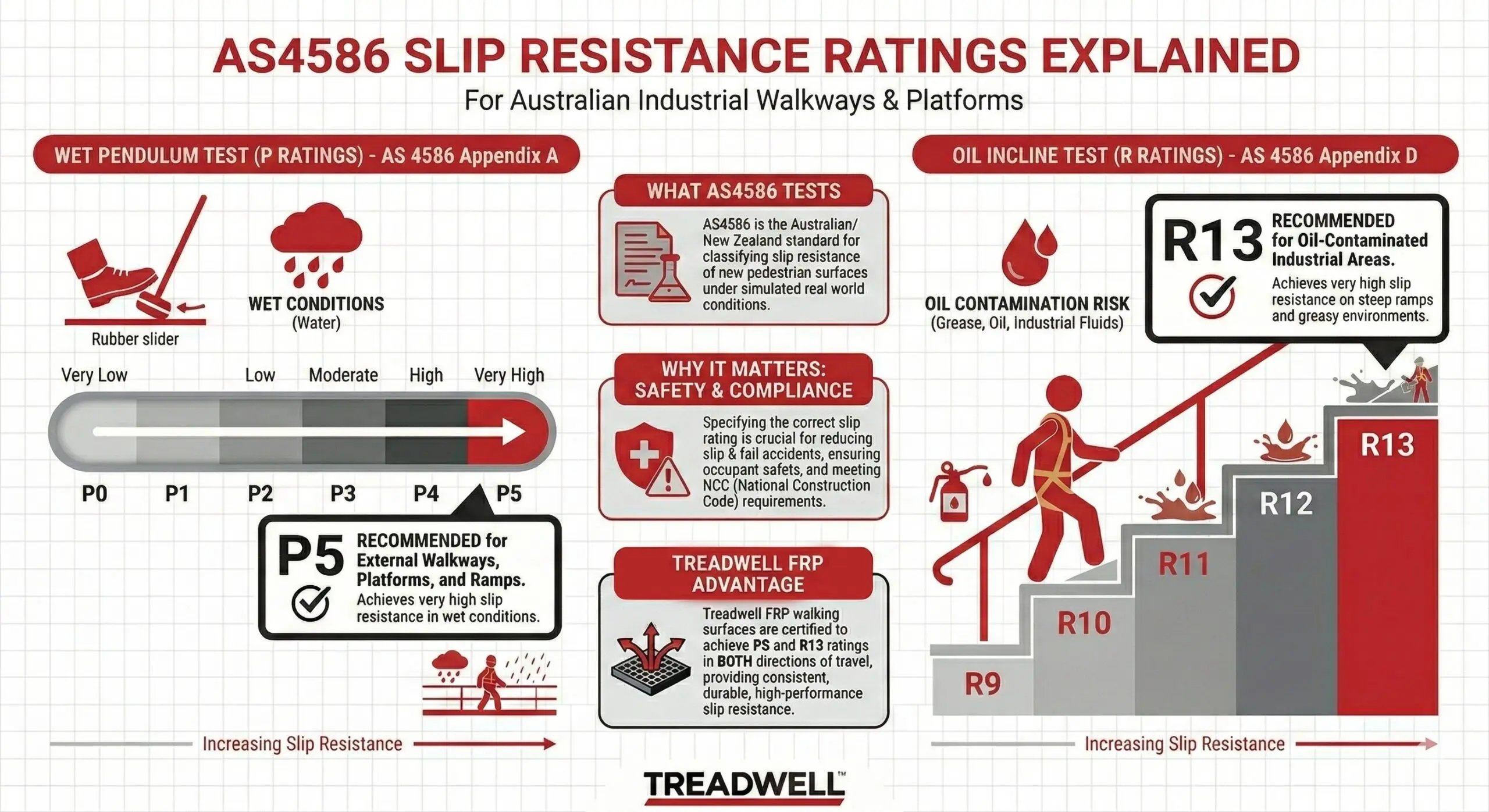
AS 4586 is the Australian and New Zealand standard that sets out how new pedestrian surface materials are tested and classified for slip resistance. It covers a range of test methods that simulate real site conditions, from wet external walkways to oil-contaminated industrial ramps.
The standard is typically used alongside the National Construction Code, which guides designers and asset owners to appropriate slip classifications for different building areas, such as external ramps, entry lobbies, and commercial kitchens.
In this Tech Talk Tuesday session, the focus is on the two most relevant test methods for FRP walkways, platforms and gratings:
- Wet pendulum test – Appendix A – P ratings
- Oil inclining ramp test – Appendix D – R ratings
Treadwell uses these methods to verify that its FRP walking surfaces achieve:
- P5 classification in the wet pendulum test
- R13 classification in the oil inclining ramp test
These are the highest slip-resistance classes in AS 4586 for the respective test methods and are suitable for high-risk external and industrial environments.
Key Benefits - Using AS 4586 for FRP Walkways and Platforms
Clear, comparable slip resistance benchmarks
AS 4586 provides defined test procedures and classification bands, which means:
- Different products can be compared on a like-for-like basis using the same test method
- Designers can specify a minimum slip classification rather than a vague description like “non-slip”
- Asset owners can demonstrate due diligence by citing a recognised standard when investigating a slip incident.
For FRP grating and panels, this allows Treadwell to publish verified P and R ratings, rather than relying on generic claims.
Performance that matches real site conditions
Different areas have different contaminants and risk profiles. AS 4586 addresses this by using multiple test methods:
Wet pendulum test – Appendix A
- The surface is flooded with water.
- A rubber slider on a swinging arm strikes the surface in a motion that simulates a heel strike.
- The distance the arm travels is converted into a British Pendulum Number, then into a P0 to P5 classification.
Oil inclining ramp test – Appendix D
- Test subject walks on a ramp coated with lubricant while harnessed for safety.
- The ramp angle is increased gradually until the subject feels close to slipping.
- The limiting angle is used to assign an R9 to R13 classification.
By using both tests, designers can match the classification to real conditions: wet-only areas, versus heavy industrial environments where oil and other contaminants are present.
Highest slip resistance classes - P5 and R13
For demanding environments like industrial walkways, jetties and access platforms, the webinar emphasises aiming for the highest practical classifications:
- P5 – very high slip resistance in wet conditions
- R13 – very high slip resistance in heavily contaminated conditions, suitable for steep ramps and industrial areas where oil exposure is expected
A high slip rating:
- Reduces the risk of slip and fall incidents
- Assists in meeting or exceeding minimum NCC recommendations for external ramps and entries
- Provides an additional safety margin as surfaces wear over time
Applications - Where P5 and R13 FRP Surfaces Make Sense
External walkways, platforms and boardwalks
For outdoor pedestrian routes exposed to rain, spray or washdown:
- FRP grating and deck panels tested to AS 4586 Appendix A with a P5 rating help maintain grip even when consistently wet
- Typical use cases include coastal boardwalks, jetties, access platforms in treatment plants and industrial facility walkways.
Industrial ramps and process areas with oil and debris
In processing plants, mines, ports and heavy industry, contaminants on the walking surface are rarely just water. Oil, grease, slurry and other residues can significantly reduce friction if the surfacing is not aggressive enough.
For these environments, surfaces should be evaluated using the oil inclining ramp test (Appendix D), and a target of R13 provides the highest slip resistance classification in the standard. Typical applications include:
- Access ramps adjacent to conveyors
- Maintenance platforms around rotating equipment
- Walkways in water and wastewater plants, where biofilms and sludge can accumulate
- Loading areas exposed to hydraulic oil and fuel
High-risk zones are defined in the National Construction Code
The NCC references AS 4586 to guide appropriate slip resistance in different building zones. Areas such as:
- External stairways and ramps
- Entry lobbies are subject to tracked-in water
- Commercial food preparation areas
All benefit from surfaces that meet or exceed recommended classifications. FRP systems with verified P5 and R13 ratings can help exceed those minimums, especially where durability and corrosion resistance are also required.
Key Moments
- 00:51 📜 AS/NZS 4586 standard sets out testing and classification for slip resistance of pedestrian surfaces.
- 02:18 🔍 Focus on Appendix A (wet pendulum) and Appendix D (oil incline); brief on B (dry) and C (barefoot).
- 02:30 🎯 Specify slip resistance relevant to environment (e.g., wet, oily) for risk mitigation and product comparison.
- 03:27 🧪 Appendix A: Wet pendulum test simulates heel strike on wet surface; classifies P0 (low) to P5 (high).
- 04:46 💧 P5 suitable for high-risk wet areas like ramps, walkways, outdoors.
- 05:28 ⭐ Treadwell products achieve P5 rating under AS/NZS 4586.
- 05:41 ⚠️ P5 requires aggressive surface texture; smooth finishes slip easily.
- 06:36 ➡️ FRP slip resistance is isotropic (same in all directions, no orientation needed).
- 07:03 🛤️ Recommend P5 for boardwalks, jetties, external walkways to maximize safety.
- 07:46 📋 National Construction Code sets minimum AS/NZS 4586 requirements; aim highest possible.
- 08:38 🛢️ Appendix D: Oil incline test for contaminated surfaces; classifies R9 (low) to R13 (high).
- 09:18 🏭 R13 ideal for industrial areas with oil (machinery, ports, mines, water treatment).
- 10:38 📏 R ratings indicate safe slopes (e.g., R13 >35°), but check AS 1657/AS 1428 for walkways/ramps.
- 12:31 🏆 Treadwell FRP achieves R13 oil-wet resistance.
- 12:58 ⚖️ Use P for wet, R for oily; products may excel in one but not the other.
- 14:06 🧫 Wet pendulum testable in situ/lab; oil incline lab-only (large samples needed).
- 15:17 🚫 R13 not for kitchens; use Appendix B (dry) or C (barefoot) for indoors.
Why Treadwell?
Treadwell positions its FRP systems not just as corrosion-resistant structural products, but as complete access solutions that address slip risk in line with AS 4586 and NCC expectations.
Choosing Treadwell for slip-resistant FRP walkways and platforms gives you:
- Verified slip ratings – products tested to AS 4586 methods, achieving P5 in the wet pendulum test and R13 in the oil inclining ramp test for very high slip resistance
- Consistent performance in both directions – FRP grating surfaces provide similar slip resistance regardless of walking direction, simplifying layout compared with some directional profiled materials
- Fit for purpose recommendations – guidance on when to specify P classifications, when R classifications are more relevant and how this ties back to NCC usage zones and risk level.
- Durable anti-slip surfaces – aggressive, integrated non-slip textures designed for long service life in external and industrial environments, with resistance to corrosion, UV and chemical exposure
- Project-specific support – the webinar explicitly invites project-specific discussions, so Treadwell can help align test method, slip classification and FRP product selection to the conditions on your site
By aligning FRP surface selection with AS 4586 and targeting P5 and R13 classifications where appropriate, Treadwell helps designers, contractors and asset owners reduce slip risk while maintaining all the usual benefits of FRP – low maintenance, corrosion resistance and long service life.