 AU
AU
 NZ
NZ
 UK
UK

Fibreglass Reinforced Polymer (FRP) is a composite material made from glass fibres embedded within a resin matrix. The glass fibres provide strength and stiffness, while the resin binds and protects the fibres, creating a material that is lightweight, durable, and resistant to corrosion.
FRP has become a widely specified material across various projects, present in diverse industrial sectors — where traditional materials such as steel or timber may be susceptible to corrosion, rot, or ongoing maintenance requirements. Treadwell’s FRP solutions are commonly used for access systems, handrails, walkways, structural components, cable management systems, and other infrastructure applications.
Why is FRP Used?
The key advantage of FRP is its high strength-to-weight ratio. FRP can deliver structural performance while remaining significantly lighter than many conventional construction materials.
Key benefits include:
- Lightweight and easy to install
- Excellent corrosion resistance
- High durability in harsh environments
- Low maintenance requirements
- Non-conductive and low thermal conductivity
- Long service life
These properties make FRP particularly suitable for environments exposed to chemicals, moisture, saltwater, or constant weather exposure.
How Does FRP Compare to Steel and Timber?
Both steel and timber remain important engineering materials, however, they can face challenges in aggressive environments.
Steel may require protective coatings, inspections, and maintenance to manage corrosion. Timber can be vulnerable to rot, moisture ingress, and biological degradation over time.
FRP offers a practical alternative because it does not rust, is resistant to moisture, and performs well in corrosive environments. This often results in reduced maintenance requirements and lower maintenance costs for asset owners.
| Property | FRP | Steel | Timber |
|---|---|---|---|
| Corrosion Resistance | Excellent | Moderate | Low |
| Weight | Lightweight | Heavy | Moderate |
| Maintenance | Low | Moderate to High | Moderate to High |
| Moisture Resistance | Excellent | Can Corrode | Can Rot |
| Lifecycle Performance | High | Maintenance Dependent | Environment Dependent |
Is FRP Safe for Infrastructure Applications?
FRP is widely used in safety-critical infrastructure because it can be engineered to meet project-specific performance requirements.
Treadwell FRP products incorporate:
- UV-resistant formulations
- Fire-retardant properties – it will not provide fuel to a fire
- Impregnated anti-slip surfaces – reducing the risk of delamination
- Chemical-resistant resin systems
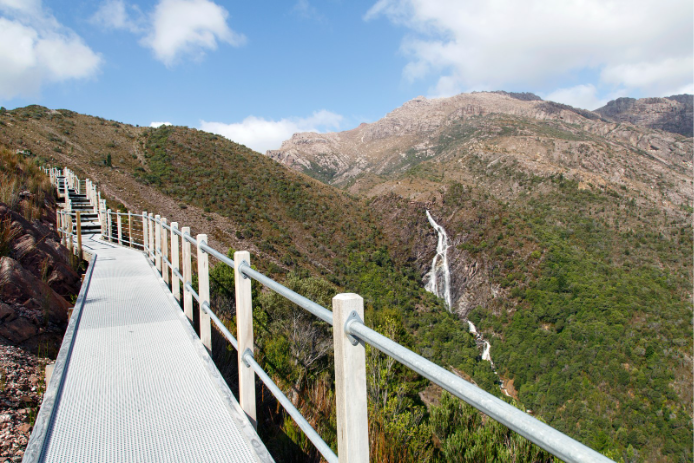
Horsetail Falls Boardwalk installed in 2021, Tasmania
The material’s corrosion resistance maintains asset integrity over time, reducing risks associated with material degradation in harsh operating environments.
Where is FRP Commonly Used?
Treadwell FRP has been used across a diverse range of industries where durability and reliability are essential.
Mining and Minerals Processing
FRP is commonly used for walkways, platforms, handrails, ladders, and cable management systems in corrosive and demanding operating environments.
Water and Wastewater
Water treatment facilities frequently use FRP for access structures, grating, odour control systems, ducting, stacks and maintenance platforms due to its resistance to chemicals and moisture.
Marine and Coastal Infrastructure
Because FRP is highly resistant to saltwater exposure, it is often specified for boardwalks, jetties, pontoons, and coastal infrastructure.
Rail, Utilities and Industrial Facilities
The lightweight, corrosion-resistant, and non-conductive properties of FRP make it well suited for access systems and infrastructure supporting utilities, transport networks, and processing facilities.