 AU
AU
 NZ
NZ
 UK
UK

For decades, steel and timber have been the materials of choice for industrial and infrastructure projects. From walkways and handrails to platforms and support structures, these traditional materials have been trusted for their strength, availability, and familiarity.
However, as asset owners and engineers increasingly place greater emphasis on durability, maintenance, and whole-of-life performance, Fibreglass Reinforced Polymer (FRP) is becoming an increasingly popular alternative.
So how does FRP compare to steel and timber?
Why Steel and Timber Have Been the Traditional Choice
Steel is widely used for its strength and structural capability, making it suitable for a broad range of industrial applications.
Timber has also played an important role in infrastructure; applications range from public access structures, boardwalks, and infrastructure projects due to its availability and ease of construction.
While both materials remain effective in many applications, they can face challenges when exposed to harsh environments:
- Steel can corrode, requiring ongoing maintenance and protective treatments.
- Timber can absorb moisture, rot, and become susceptible to degradation over time.
- Both materials may require repair, refurbishment, or replacement throughout their service life.
This is where FRP offers a different approach.
Fibreglass Reinforced Polymer (FRP) is a composite material manufactured from glass fibres and polymer resins. It is engineered to provide structural performance while offering excellent resistance to corrosion, chemicals, moisture, and environmental exposure.
Unlike traditional materials that often rely on coatings or treatments for protection, FRP’s resistance to degradation is built into the material itself.
For asset owners, this translates to longer asset life and reduced maintenance requirements.
| Consideration | FRP | Steel | Timber |
|---|---|---|---|
| Structural Performance | Engineered for a wide range of access and structural applications | High strength | Suitable for many structural applications |
| Corrosion Resistance | Excellent | Requires protection in corrosive environments | Can deteriorate in wet conditions |
| Chemical Resistance | Excellent | Can be affected by aggressive chemicals | Limited |
| Moisture Resistance | Excellent | Corrosion risk | Can absorb moisture and rot |
| Weight | Lightweight | Heavy | Moderate |
| Maintenance Requirements | Low | Moderate to High | Moderate to High |
| Design Life | Over 55 Years | Dependent on environment and maintenance | Dependent on environment and maintenance |
| Electrical Conductivity | Non-conductive | Conductive | Non-conductive |
| Key Advantage | Corrosion-resistant and low maintenance | Established structural material | Readily available and easy to work with |
| Key Limitation | Higher initial investment in some applications | Ongoing corrosion management | Susceptible to weathering and biological degradation |
Looking Beyond Initial Cost
While upfront cost is often a factor in material selection, long-term performance is equally important.
Materials exposed to moisture, chemicals, extreme weather conditions, or harsh operating conditions can require ongoing inspections, repairs, coatings, and maintenance throughout their service life. Over time, these activities can add significantly to the total cost of an asset.
This is why many engineers, project managers, and asset owners now assess materials based on whole-of-life performance, rather than initial cost alone.
Where FRP Adds the Most Value
FRP is particularly effective in environments where corrosion, chemical exposure, or moisture are ongoing challenges, including:
- Mining and mineral processing facilities
- Water and wastewater treatment plants
- Marine and coastal infrastructure
- Utilities and energy assets
- Industrial processing facilities
- Public infrastructure and boardwalks
In these applications, durability and reduced maintenance requirements often become key drivers of material selection.
Built for Long-Term Asset Performance
Treadwell FRP products and systems are engineered for a design life exceeding 55-years and are designed to withstand:
- Corrosion resistance
- Chemical exposure
- UV degradation
- Harsh operating environments
Compared to traditional materials such as steel and timber, FRP requires significantly less maintenance while delivering reliable long-term performance.
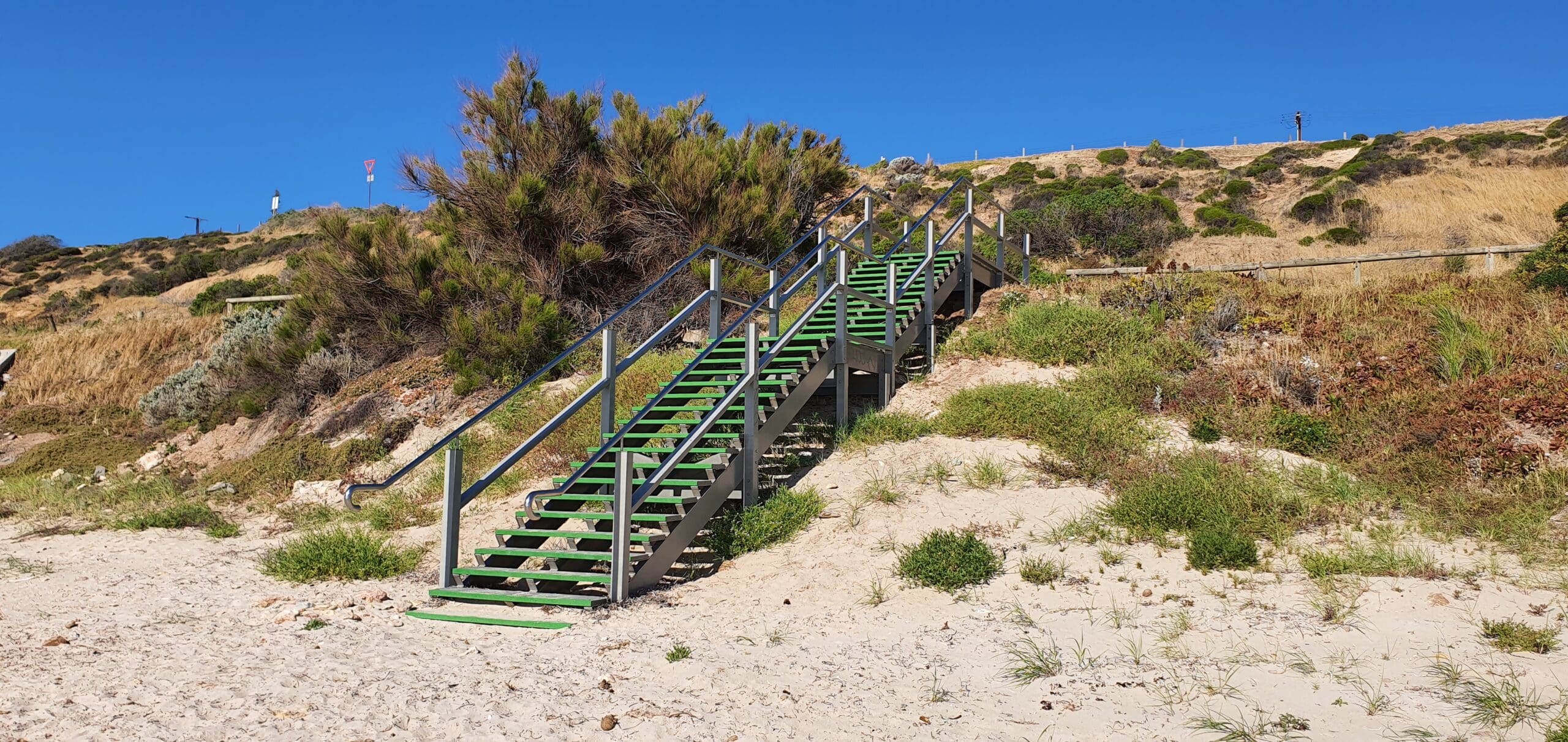
Thomas Street, Aldinga Beach Reserve - Beach Access Staircase, photo taken in 2019.
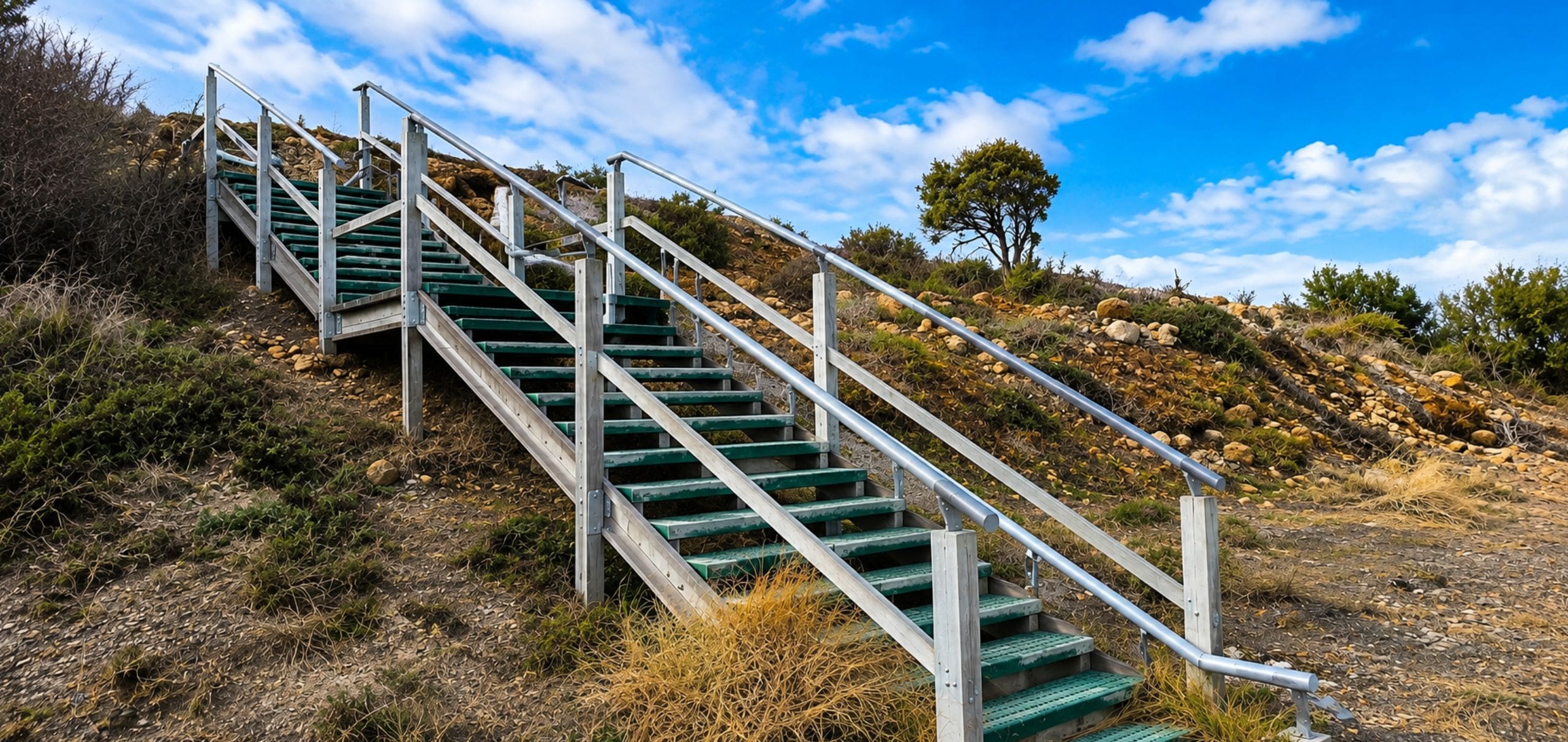
Same staircase, photo taken in 2024.
Installed in 2019, the Aldinga Beach Access Staircase continues to demonstrate the long-term durability of FRP, maintaining its appearance and performance in a harsh coastal environment.
For industry experts from project managers to engineers, this means fewer maintenance interventions, lower lifecycle costs, and infrastructure that continues to perform in demanding environments for decades.